Begin with what suits you now
You can start suitable physical activity at your current size. Choose equipment and movements that fit, begin within your current ability and build gradually. Health concerns may need individual advice first.
An imagined first visit: a Hyderabad beginner brings a saved routine that says “easy walking” and “beginner push-ups”. She would like the word “easy” to explain itself.
Evidence: [1]
The same activity can ask different things of people
A treadmill speed is a setting, not a personal effort rating. The same activity can be demanding for one person and comfortable for another. Body size alone does not supply that missing information.
For aerobic exercise, CDC’s talk-test rule of thumb describes moderate effort as being able to talk but not sing. You can begin more gently and build from there. Severe or unusual breathlessness is a reason to stop and get help, not to apply a talk test and carry on.
Three labels that need a closer look
“Easy walking”
Ask whose effort is being described. Adjust the starting pace to your current ability; a shared speed is not a shared effort.
“Only bodyweight”
Your body supplies resistance. Ask for a suitable movement version rather than assuming no dumbbell means an easy exercise.
“Supported machine”
Support does not settle fit. Check adjustments, stated user limits and how to get on, off and stop safely.
Choose one starting activity, then check the fit
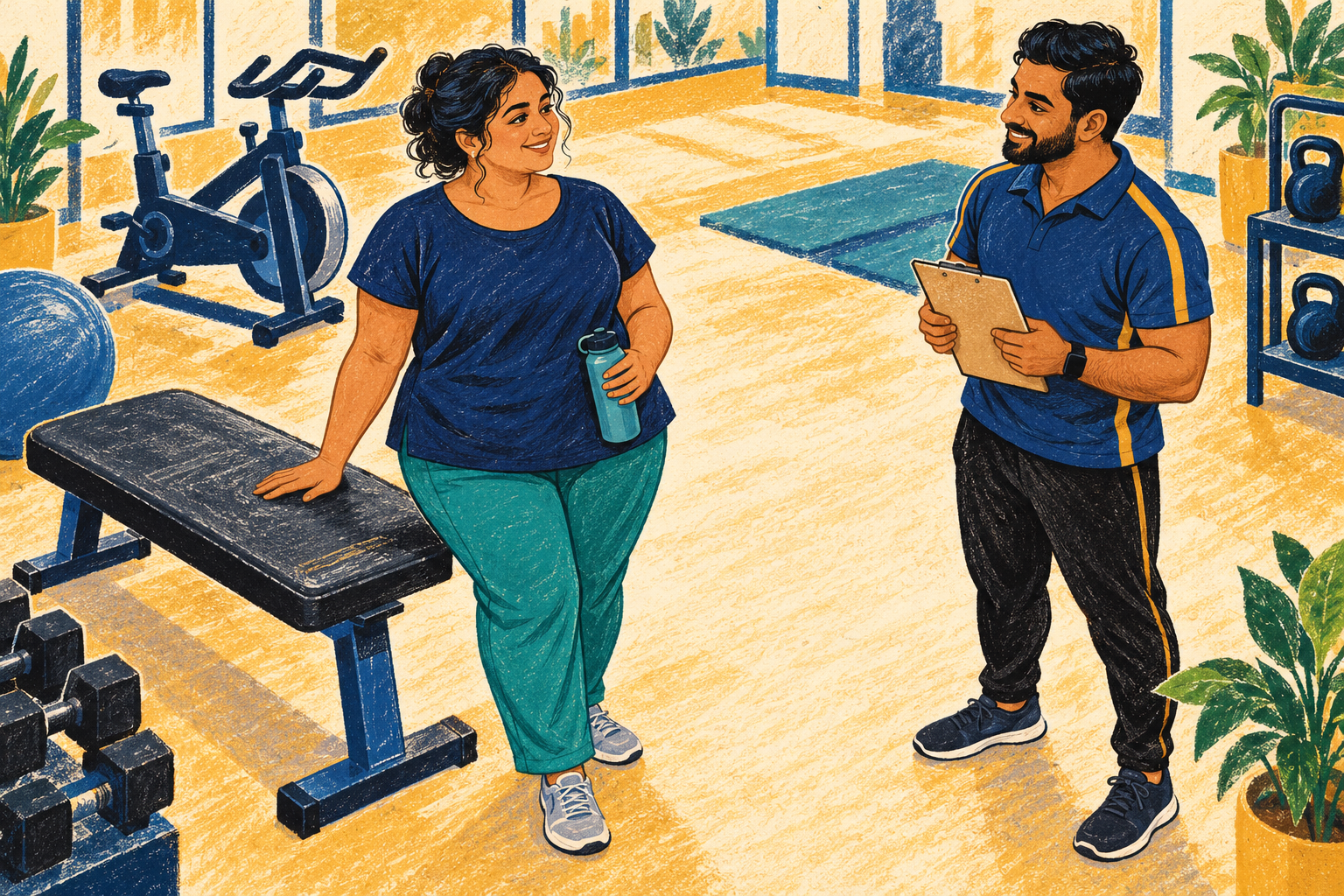
Our imagined beginner can discuss level walking or a suitable stationary bike as an aerobic starting option. Ask which option she can use comfortably and understand.
Before using equipment, ask staff to check that it is suitable for your size, can be adjusted appropriately and is within its stated user limits. Ask how to start, stop and get on or off safely. Do not assume every bike or bench fits everyone, or force a setup that does not work.
A short, suitable spell of activity can be a starting point. You do not have to complete thirty uninterrupted minutes on day one. Ordinary walking outside the gym can contribute too.
“Bodyweight” does not mean “no resistance”
Strength exercise can use machines, free weights, bands or your own body weight. ACSM’s 2026 guidance for healthy adults supports individualising resistance work, including bodyweight options.
If the floor push-up on the saved routine is beyond her current control, she can ask a trainer about a suitable version rather than repeat it badly. The NHS strength guide includes a wall press-up as one starting option. It is an example to learn when appropriate, not a compulsory exercise for every larger beginner.
If control is lost, stop that attempt and ask about a more manageable option. Her note could read: “Wall version; return rushed; stopped—ask for an easier setup before retrying.” This illustrative note names the version, the problem and the next action. She can bring it back before doing more.
Turn one exercise into a usable next-visit note
Name the sticking point
Say what is unclear: “I cannot control the floor version” or “I do not understand this machine’s stop control.”
Learn a suitable option
Ask for a demonstration and setup check. A wall press-up is one possible alternative when appropriate; other movements may suit better.
Practise and reassess
Try the agreed manageable amount, breathing and moving with control. Reduce or stop the work if control is lost; do not push through pain.
Record the repeatable detail
Write the exercise version, relevant setup, what you completed and one question. Bring that note before changing the next visit.
Build towards a manageable week
General adult guidance includes at least 150 minutes of moderate aerobic activity across the week and two days of muscle strengthening. The minutes can be split up, and some activity is better than none. A wider strength plan should cover the major muscle groups.
Treat that as a direction to build towards, not a first-session demand. The linked four-week guide gives a fuller introductory example once suitable movements and equipment are clear. Changing everything at once makes it harder to tell what helped or what was too much.
Know when the question belongs with healthcare
If you have difficulty moving or balancing, get out of breath easily, have a chronic condition or a bone/joint problem that activity could worsen, speak with a qualified healthcare professional before starting. This guide cannot decide your individual suitability.
Stop and seek urgent medical help for chest pain or pressure, extreme shortness of breath, dizziness or feeling unwell. Ongoing activity-related joint, foot or leg pain also deserves professional advice. A different machine is not a diagnosis or a treatment for pain.
Bring the question behind the saved routine
Back to the imagined first visit: the useful next question is “Which version can I learn and repeat?” Now “easy” has a useful question beside it.
At IMFIT Madhapur, discuss Angadh if you want individual free-weight and movement practice with shared-floor trainer demonstrations and corrections. The trainer also attends to others; this differs from dedicated one-to-one PT. Strength & Cardio includes machines, free weights and cardio with trainer guidance. A fixed Shakthi small-group batch is another format to compare if its schedule and support suit you.
Ask: “Can we check which equipment fits and learn a manageable starting version?” Ask the team to check the available equipment and confirm suitable arrangements. Sunday is closed. An enquiry is a request, not a booking.
Questions people ask
Do I need jumping or running to begin?
No. Walking and suitable cycling are examples of aerobic options; beginners do not need to start with jumps or running. Choose an activity that matches your ability and health circumstances, and build from there.
Evidence: [4]
What if the equipment does not fit me?
Do not force it or improvise around its limits. Ask staff about an appropriate alternative and its setup. If a centre cannot offer suitable equipment and instruction, that is useful information when choosing where to train.
Evidence: [1]
Build your next step
Sources and further reading
- NIDDK: Staying Active at Any Size—starting safely, equipment fit, activity choices and warning symptoms
- CDC: relative aerobic intensity and the talk-test rule of thumb (4 December 2025)
- NHS: gentle strength exercises, wall press-ups and controlled movement
- CDC: adding adult activity, small amounts and weekly aerobic/strength guidance (4 December 2025)
- ACSM: 2026 resistance-training update for healthy adults; bodyweight options and individualisation
- IMFIT: current training and coaching formats; Angadh shared-floor guidance also owner-confirmed 25 October 2026
- IMFIT: visit confirmation and Sunday closure
- NIDDK: starting activity and seeking individual advice for health problems or disability
- NIH Office of Research on Women’s Health: exercise safety and warning symptoms
Sources checked 2026-10-30.
This article is for general information and does not replace professional medical advice. Consult a qualified healthcare professional for guidance suited to your needs.
Find a starting option that fits
Discuss your experience, the activity you want to learn and any equipment-fit questions. Compare shared-floor guidance, scheduled groups and dedicated personal training before choosing.
Compare coaching formats